
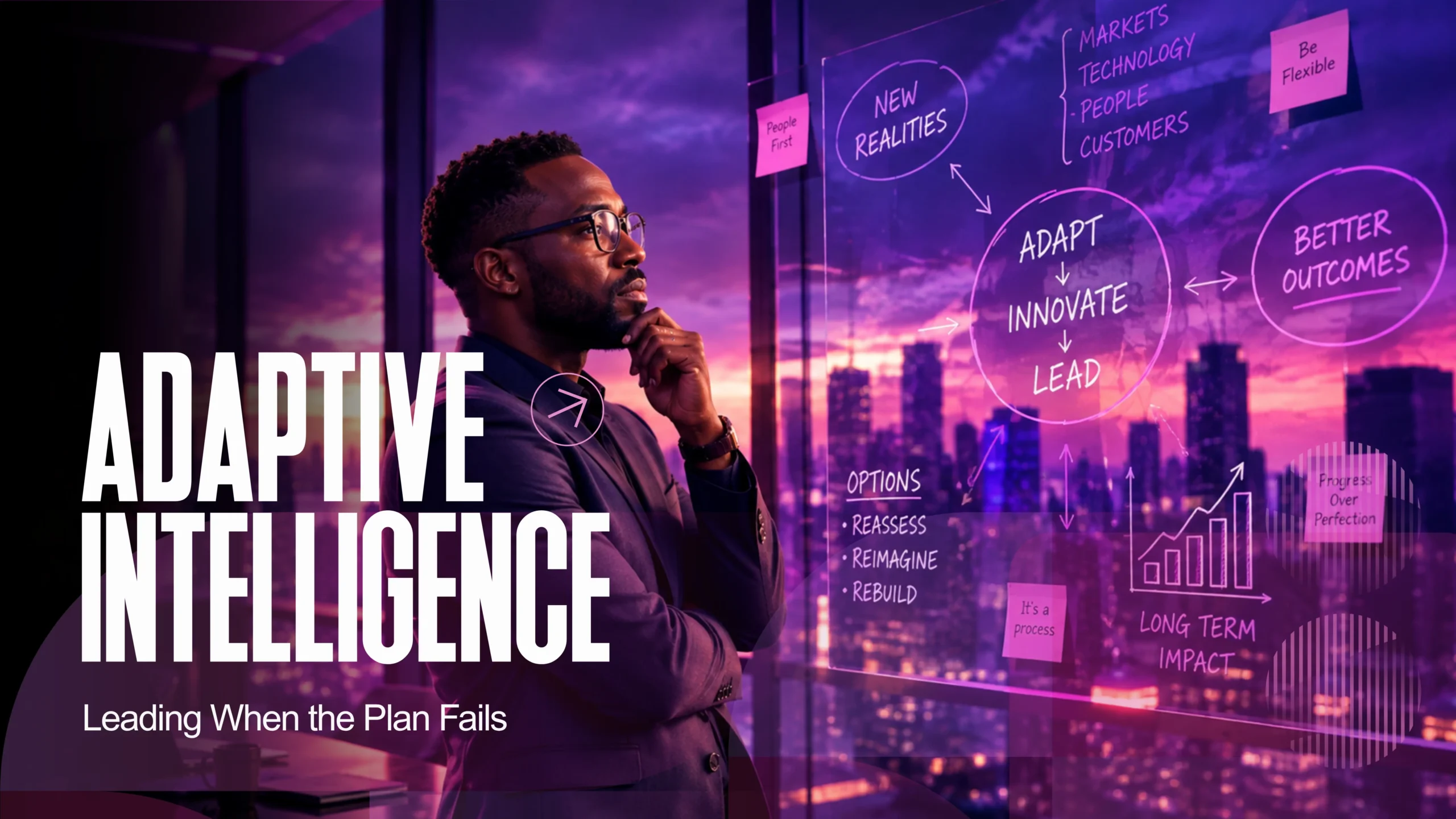
Change, we often say, is constant. But what we do not talk about enough is how some changes can alter the entire course of an organisation, career, or mission, creating disruptions that leave carefully laid plans suddenly irrelevant.
These changes could be the loss of a major client, an unexpected layoff, an economic or market disruption that invalidates years of planning, a global pandemic, a natural disaster. Sometimes, it may seem as little as a venue suddenly becoming unavailable, a key sponsor pulling out, or a critical partnership falling through. Whatever the scale, the effect can be the same. The path you carefully created to execute your mission no longer exists, and you are back to the drawing board, often without the luxury of time to stop and develop a new strategy.
In moments like these, progress depends less on having every answer and more on a readiness to act, to keep moving towards the goal even when the path ahead is unclear. But here comes the question: how do you decide what step to take next when the way forward is uncertain? More importantly, how do you lead others when they are looking to you for answers you do not have?
In this article, we will be considering two very different examples, Apollo 13 and Nelson Mandela, exploring how they managed to lead their team and themselves through uncertain situations to achieve their goals.
Leading When the Plan Fails: Apollo 13
On April 11, 1970, Apollo 13 launched from Kennedy Space Center, carrying astronauts Jim Lovell, Jack Swigert, and Fred Haise on what was meant to be NASA’s third mission to land humans on the Moon.
But 55 hours, 55 minutes and 4 seconds into the mission, about 205,000 miles from Earth, an oxygen tank exploded aboard the spacecraft. The explosion severely damaged the spacecraft, causing the loss of electrical power and oxygen and putting the mission and the lives of the three astronauts at risk.
The crew now had a new mission, not one they had originally planned for but one given to them by the circumstances at hand. And here came the question: what do they do now that the original plan had failed?
An excerpt from Flight Director Gene Kranz’s communication to the team captures the first step they took: “Okay, everybody, let’s keep cool.”
They understood that panicking would not change their circumstances. They needed to remain calm enough to understand what they were dealing with and determine what could still be done.
They also had to accept that the original objective was no longer possible. They were no longer trying to land on the Moon. The priority had changed to getting the three astronauts safely back to Earth.
And rather than wishing for resources they no longer had or dwelling on what should have happened, they focused on taking decisive actions that would lead them closer to their goal.
So, 142 hours after the explosion aboard Apollo 13, the spacecraft successfully splashed down in the Pacific Ocean, marking a remarkable achievement in crisis management and teamwork.
They did not have all the answers. They did not have the luxury of starting over. All they had was an objective, and they had to keep taking the steps that would move them towards it.
Speaking of having an objective and taking the steps that will move you towards it, even when you do not have all the answers, let’s talk about Nelson Mandela.
Moving Forward in Uncertainty: Groping in the Dark
Sometimes, moving towards our vision in a state of uncertainty can feel like groping in the dark. At times, it can seem almost as though what you are reaching for never was and may never be there. Few stories reflect this experience as well as that of Nelson Mandela.
Nelson Mandela was pursuing his vision for a free and democratic South Africa when he was arrested on August 5, 1962. In 1964, following the Rivonia Trial, he was sentenced to life imprisonment and sent to Robben Island. He would spend more than 27 years in prison.
In a situation like that, the most obvious emotion we might expect him to feel is despair, and the most obvious response might be to give up on the vision altogether.
But Mandela did the opposite.
He furthered his studies, eventually obtaining an LLB through the University of South Africa in 1989. He learned Afrikaans and studied the history and culture of the people who held him captive. He initiated contact with representatives of the apartheid government, beginning what became known as “talks about talks,” which ultimately led to the multiparty negotiations that ended apartheid.
He had no idea when or how the circumstances around him would change. He could not simply walk out of prison and begin building the future he envisioned. But he could decide what he would do with the circumstances he was in.
He famously drew strength from the poem Invictus, anchoring himself in the line:
“I am the master of my fate, I am the captain of my soul.”
Leading Through Uncertainty
Both stories, Mandela and Apollo 13, have very different settings, but they communicate the same thing: change is constant, and sometimes those changes can alter the course of an organisation, career or mission, creating unexpected complexities and uncertainty.
Whether you are leading an organisation, running a business or you are a career professional, the fact remains that what worked for you today may not work tomorrow, and a well-thought-out plan today could be completely invalidated tomorrow.
As a leader, navigating this age of disruption, just as Nelson Mandela and the Apollo 13 crew did in their own circumstances, requires the capacity to lead confidently when certainty disappears and respond intelligently to disruption.
And on October 30 and 31, at VLC 2026, you can join other visionary leaders, executives, entrepreneurs, professionals and changemakers at the 4th edition of the Visionary Leadership Conference (VLC) 2026 to learn how to do just that.
With the theme “Executing Vision in an Age of Disruption,” VLC 2026 goes beyond conventional leadership conversations. It is a learning experience designed to help leaders understand how to navigate the realities of a changing world, adapt their approach and keep moving towards their vision even when the path ahead is uncertain.
Through real-world case studies, practical frameworks and insights from experienced practitioners, VLC 2026 will give you the opportunity to learn from what others have done, understand what made their responses effective and explore how you can apply those lessons to your own organisation, business or career.
Register now to secure your place at VLC 2026 and connect with a network of leaders preparing to lead, adapt and execute in an age of disruption.